
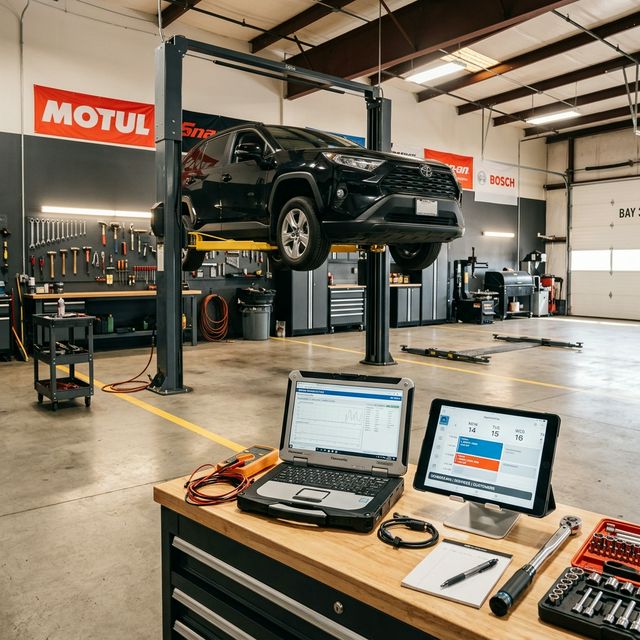
Your technician is elbow-deep in a transmission rebuild when the shop phone rings. The service writer is already on another call. The customer waiting for a brake estimate has been standing at the counter for five minutes. That incoming call? It rings six times and goes to voicemail.
The caller — who needs a $2,200 engine diagnostic — hangs up and calls the shop down the street.
This scenario plays out 20 to 30 times per day at the average independent auto repair shop. According to Marchex automotive data, service departments miss 20-30% of inbound calls, and 62% of those callers never try again. They go straight to a competitor who picks up the phone.
At an average ticket value of $500, missing just 5 calls a day costs your shop $12,500 per week in potential revenue. Over a year, that's over $600,000 walking out the door.
An AI receptionist changes that equation entirely.
Why Auto Repair Shops Have a Uniquely Difficult Phone Problem
Unlike a dentist's office or a law firm, auto repair shops face a collision of operational realities that make phone management brutally hard.
Your Best People Are Under Cars, Not Behind Desks
In a 4-bay shop, you might have 3-4 technicians and one service writer. That service writer is simultaneously writing estimates, explaining repairs to walk-ins, checking parts availability, and answering the phone. Something has to give — and it's usually the phone.
Call Volume Spikes Are Unpredictable
Monday mornings after a cold weekend? Your phone explodes. First warm day of spring? Every "check engine light" that was ignored all winter suddenly matters. These spikes are impossible to staff for because hiring a second service writer for 15 peak hours a week doesn't make financial sense.
Callers Want Answers You Can't Give Immediately
"Is my car ready?" "How much to replace brake pads on a 2019 F-150?" "Do you work on BMWs?" These questions require either a quick lookup or a knowledgeable answer — and they come in dozens per day. Every one of them takes the service writer away from billable work.
After-Hours Calls Are Revenue Calls
A car breaks down at 7 PM on a Tuesday. The owner Googles "auto repair near me," sees your shop, and calls. Voicemail. They call the next result. That customer — and their $800 repair — is gone before you open the next morning.
How an AI Receptionist Works in an Auto Repair Shop
An AI receptionist isn't a chatbot or a phone tree. It's a voice-powered virtual assistant that answers your phone like a trained service writer — 24 hours a day, 7 days a week.
Here's what it handles for a typical shop:
Appointment Scheduling and Service Booking
The AI answers the call, greets the customer by name (if they're in your system), asks what service they need, and books them into your next available slot. It syncs directly with your shop management system — whether that's Tekmetric, Shop-Ware, Mitchell, or even a Google Calendar setup.
No double-bookings. No phone tag. No sticky notes that get lost.
"Is My Car Ready?" Status Calls
This is the #1 time-waster for service writers. Studies show that 30-40% of inbound calls to auto repair shops are status checks. An AI receptionist pulls the job status from your system and gives the customer an instant update:
"Hi Mike, your 2021 Camry is currently in the shop. The technician has completed the brake pad replacement, and we're waiting on an alignment. We estimate it'll be ready by 4 PM today. Would you like a text when it's done?"
That's a two-minute call handled in 30 seconds — without your service writer ever looking up from an estimate.
New Customer Intake and Quote Requests
When a new customer calls asking about pricing, the AI gathers key details: vehicle year, make, model, mileage, and the issue they're experiencing. It can provide a general price range for common services (oil changes, brake jobs, tire rotations) and schedule a diagnostic for anything complex.
Instead of losing that caller to voicemail, you now have their information, their vehicle details, and an appointment on the books before the conversation ends.
After-Hours Emergency and Tow Coordination
A driver whose car just died at 9 PM on a Thursday doesn't want to leave a voicemail. An AI receptionist takes the call, captures the vehicle information and location, and sends an alert to the shop owner or service manager. If you work with a preferred towing company, the AI can provide that number directly.
No missed emergency. No revenue walking to the shop down the road.
Service Reminders and Follow-Up Calls
The AI can also make outbound calls to remind customers about upcoming maintenance — oil changes, tire rotations, state inspections. These proactive touchpoints bring customers back before they forget or go somewhere else.
The ROI Math: What an AI Receptionist Saves Your Shop
Let's break down the numbers for a typical 3-4 bay independent auto repair shop:
| Metric | Without AI Receptionist | With AI Receptionist |
|---|---|---|
| Calls answered per day | 70% (miss ~15-20 calls) | 100% (every call answered) |
| Average ticket value | $500 | $500 |
| Weekly revenue from recovered calls | $0 | $5,000-$10,000 |
| Service writer time on status calls | 2-3 hours/day | 15 min/day |
| After-hours calls captured | 0% | 100% |
| Monthly AI receptionist cost | — | $200-$500 |
A conservative estimate puts the monthly revenue recovery at $20,000-$40,000 from calls that previously went unanswered. Against a monthly cost of a few hundred dollars, the ROI is 40x or higher.
Even if only 10% of those recovered calls convert to booked appointments, you're still looking at $2,000-$4,000 in additional monthly revenue — making the AI receptionist one of the cheapest, highest-return investments your shop can make.
What to Look for in an AI Receptionist for Your Auto Repair Shop
Not every AI phone system is built for the auto repair industry. Here's what matters:
Shop Management System Integration
Your AI receptionist needs to connect to your shop management software (Tekmetric, Shop-Ware, Mitchell 1, Shopmonkey, or whatever you use). Without this integration, it can't pull vehicle status, check appointment availability, or log new customer details.
Automotive Knowledge Base
The AI should understand common auto repair terminology — not just "brake pads" but "CV axle," "timing belt," "catalytic converter," and "OBD-II diagnostic." It needs to sound like it belongs in your shop, not like a generic answering service reading from a script.
Bilingual Support
In many markets, 30-40% of auto repair customers are Spanish-speaking. An AI receptionist that handles calls in both English and Spanish captures revenue that a monolingual answering service leaves on the table.
Instant SMS Follow-Up
After every call, the AI should text the customer a confirmation with their appointment time, your shop address, and what to expect. This reduces no-shows and gives the customer confidence that their call was handled — not lost in voicemail limbo.
Customizable Call Routing
For true emergencies or high-value customers, the AI should be able to route calls directly to the shop owner or manager's cell phone. Not every call needs AI handling — but the AI should be smart enough to know the difference.
Real-World Auto Shop Scenarios: AI vs. No AI
Scenario 1: Monday Morning Rush
Without AI: Phone starts ringing at 7:30 AM. Service writer handles the first 3 calls, then a walk-in arrives needing an estimate. The next 8 calls go to voicemail. Three customers drive to a competitor instead.
With AI: All calls are answered within 2 rings. The AI books 6 appointments, answers 4 status questions, and texts the service writer a summary of every interaction. The walk-in customer gets full attention from the service writer.
Scenario 2: Saturday Breakdown
Without AI: Shop is closed. Customer's car won't start in a grocery store parking lot. They call your number, get voicemail, and Google "auto repair open Saturday near me."
With AI: The AI answers, captures the vehicle details and location, and tells the customer: "We're open Monday at 7:30 AM. I've scheduled you for the first appointment. Would you like our recommended towing partner's number?" The customer is booked before they make another call.
Scenario 3: The "How Much?" Call
Without AI: A caller asks how much a timing belt replacement costs on a 2018 Honda Civic. The service writer is with another customer. The call goes to voicemail. The caller gets a quote from the shop that answered.
With AI: The AI provides a price range ($400-$700 depending on condition), explains what's included, and books a diagnostic appointment. The caller becomes a customer.
Common Objections from Shop Owners (And the Real Answers)
"My customers want to talk to a real person."
They want their call answered. Research shows that 62% of callers who reach voicemail never call back — they call the next shop. An AI receptionist that answers instantly and handles 80% of routine questions is far better than a human who doesn't pick up.
For complex questions or upset customers, the AI routes the call to your service writer or owner directly.
"I don't trust technology to get the details right."
Modern AI receptionists transcribe every call, log every detail, and send you a written summary after each interaction. You actually get better documentation than a sticky note or a service writer trying to remember a conversation from three hours ago.
"What about customers with unusual requests?"
The AI handles the 80% of calls that are routine: appointments, status checks, hours, pricing questions, directions. When something unusual comes in — a custom fabrication request, a warranty dispute, a complaint — it routes the call to a human. You handle the exceptions; the AI handles the volume.
Getting Started: 3 Steps to AI-Powered Phone Answering for Your Shop
Step 1: Audit your missed calls. Check your phone system's call log for the past 30 days. Count how many calls went to voicemail or rang out. Multiply by your average ticket value. That number is the revenue at stake.
Step 2: Try a live demo. See how Greetly AI handles auto repair calls — including appointment booking, status updates, and after-hours capture. You'll hear exactly what your customers would hear.
Step 3: Set up in a day. Most AI receptionists can be configured and live within 24 hours. You provide your shop hours, services, pricing ranges, and connect your scheduling system. The AI handles the rest.
Your technicians should be fixing cars, your service writer should be writing estimates, and every single call should get answered. That's what an AI receptionist does for auto repair shops.
FAQ
How much does an AI receptionist cost for an auto repair shop?
Most AI receptionist services for auto repair shops cost between $200 and $500 per month, depending on call volume and features. Compare that to a part-time receptionist at $2,000-$3,000/month or a traditional answering service at $300-$800/month that can't book appointments or check repair status. For shops missing 15+ calls a day, the AI typically pays for itself within the first week.
Can an AI receptionist integrate with my shop management software?
Yes. Modern AI receptionists integrate with popular shop management platforms including Tekmetric, Shop-Ware, Mitchell 1, and Shopmonkey. The integration allows the AI to check appointment availability, pull vehicle repair status, and log new customer information directly into your existing system — no duplicate data entry required.
Will my customers know they're talking to an AI?
Today's AI voice technology sounds remarkably natural — far from the robotic voices of a few years ago. Most customers won't notice, and the ones who do generally don't mind as long as their question gets answered quickly. What customers do notice is when their call goes to voicemail or sits on hold for five minutes. An AI that answers in two rings and solves their problem beats a human who never picks up.
What happens when the AI can't answer a question?
The AI handles routine calls — appointments, status checks, pricing, hours, and basic service questions. When a caller has an unusual request, a complaint, or a technical question beyond the AI's scope, it seamlessly transfers the call to your service writer or shop owner. The caller doesn't get stuck in a loop; they get connected to a person who can help, along with a summary of what they've already told the AI.
Does it work for multi-location auto repair chains?
Absolutely. AI receptionists can handle call routing across multiple locations, each with its own hours, service menu, and appointment calendar. Callers are routed to the correct location based on their area code or stated preference, and each location gets its own call analytics and reporting. This makes it particularly valuable for chains looking to maintain consistent service quality across all shops.